
Last updated September 10, 2026
Full 25-point door and opener safety check with every visit - springs, cables, rollers, tracks, and your LiftMaster or Chamberlain opener included
You get a price before we start. It does not change when the truck arrives.
 Before
 After
After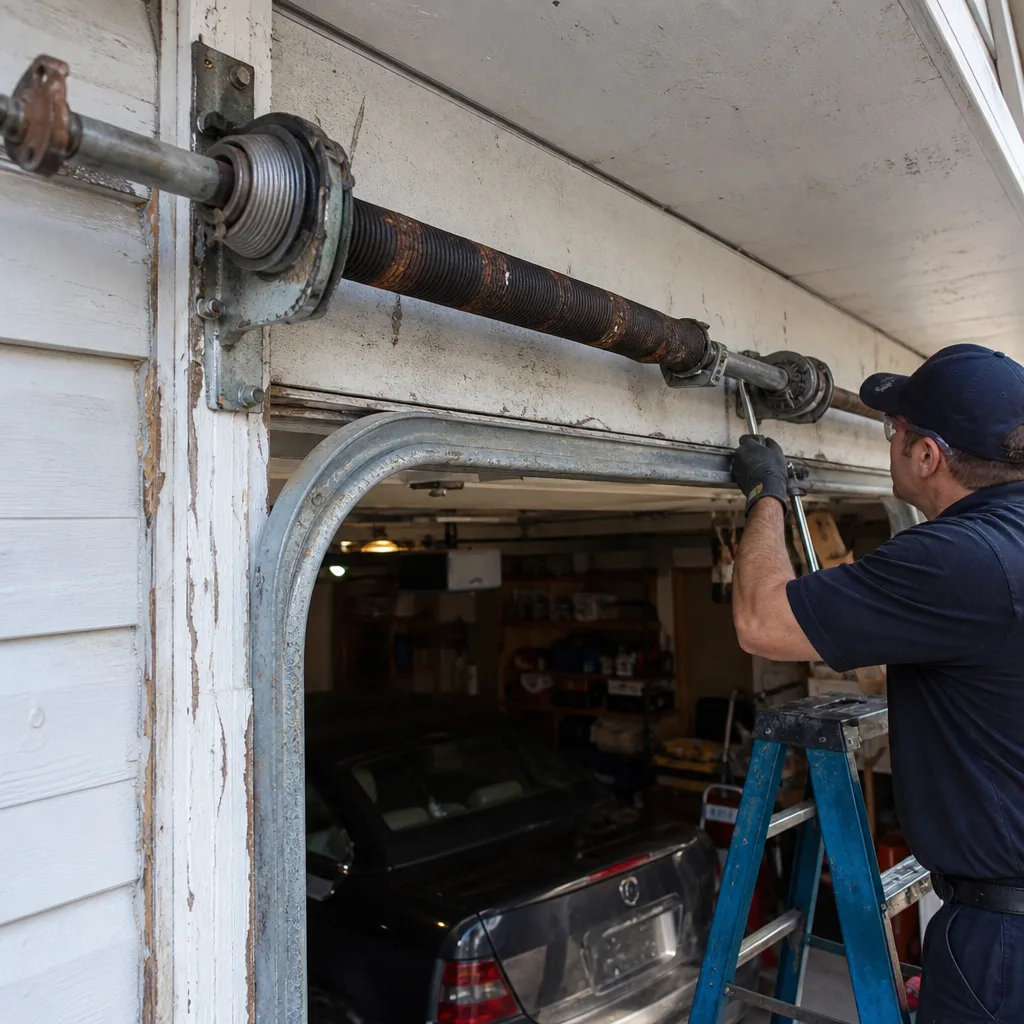 Before
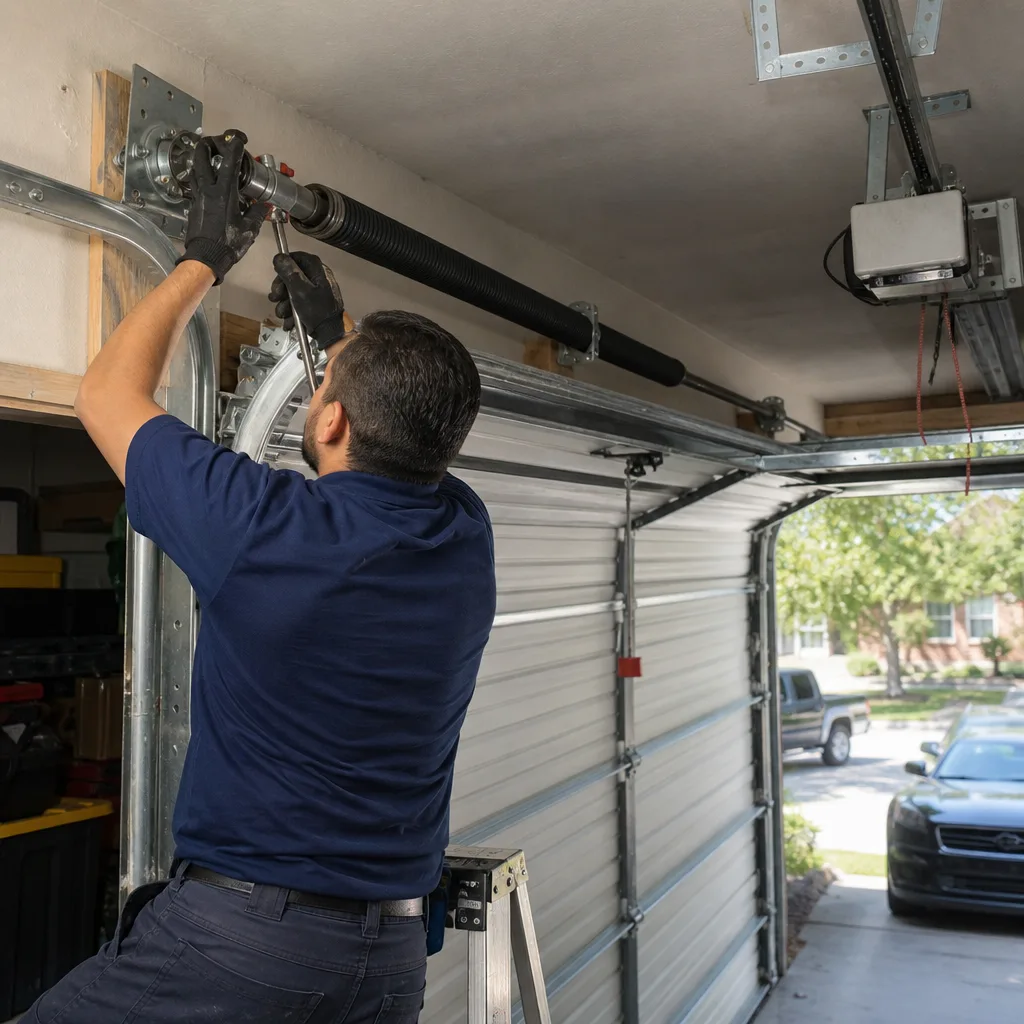 After
After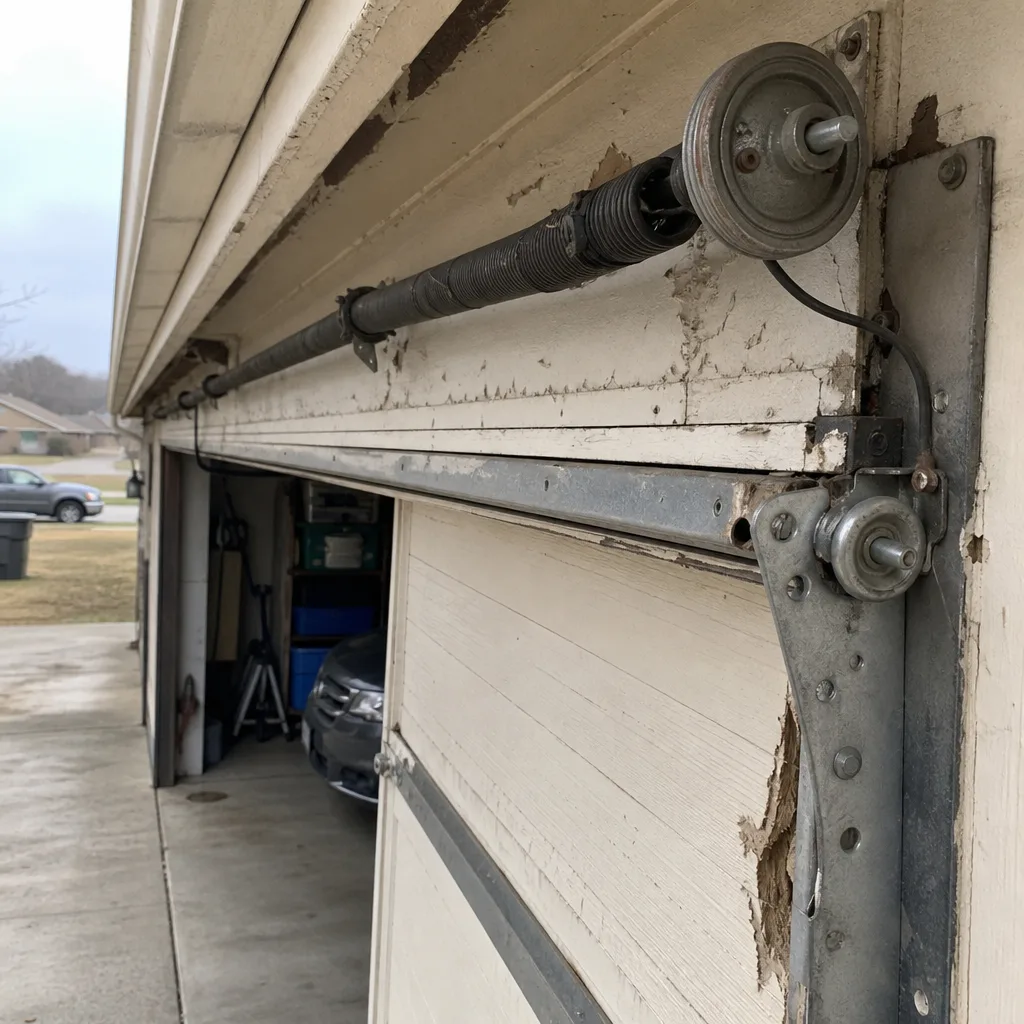 Before
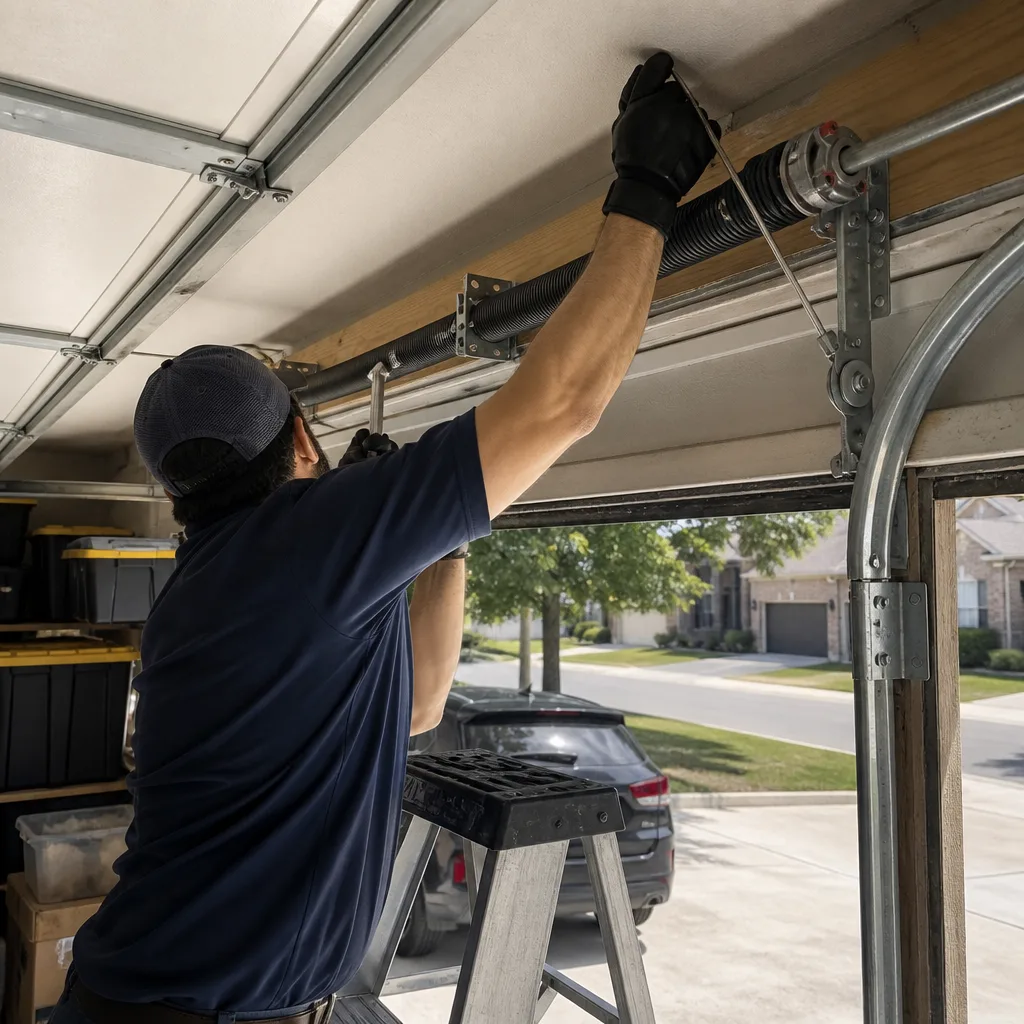 After
AfterGarage Door Warning Signs: A Denton Homeowner’s Reference Guide
A garage door that hesitates for half a second before reversing is not “just stiff.” It is a door whose safety reversal mechanism is operating outside its calibrated range, which is the same system that is supposed to stop the door from closing on a child. In Denton, where summer heat pushes metal components past 140 degrees and winter northers can snap a brittle cable, these small signals compound fast. Most garage door failures announce themselves days or weeks in advance through sounds, movements, and visual cues that owners learn to ignore. This guide reframes those signals as a diagnostic language and tells Denton homeowners precisely what each one means and how long they have before it becomes an emergency, complementing our Complete Guide to Garage Door in Denton.
Quick Answer
The most critical garage door warning signs are: a door that reverses before touching the floor, grinding or popping sounds during operation, visible gaps in torsion or extension springs, frayed cables with broken strands, and a door that hangs unevenly or shudders in its tracks. These symptoms indicate component failure in progress, not normal wear, and in Denton’s climate they typically progress from warning to breakdown within 2 to 6 weeks, as detailed in our Seasonal Garage Door Care for Denton: Year-Round Homeowner’s Guide.
Table of Contents
- Sound Dictionary: What Your Garage Door Is Telling You
- The Three Movement Anomalies and What They Reveal
- Why “Works Fine Most of the Time” Is More Urgent Than Total Failure
- The Two-Minute Visual Checklist: Go/No-Go Standards
- Opener Warning Signs Mistaken for Remote Battery Problems
- How Denton’s Climate Accelerates Specific Failures
- Common Mistakes to Avoid
- When to Call a Professional
- Frequently Asked Questions
Sound Dictionary: What Your Garage Door Is Telling You
Every sound a garage door makes has a mechanical source. Learning to match the sound to the component saves time, prevents misdiagnosis, and keeps homeowners from replacing the wrong part.
The Pop
A sharp, single pop during opening or closing, often accompanied by a visible jolt of the door, almost always signals a torsion spring wind or unwind event. Torsion springs store enormous mechanical energy, typically 10,000 to 15,000 cycles of tension. When a spring begins to fail, individual coils can slip past each other or a section can fracture internally before the break becomes visible. The pop is that slip.
In Denton homes built during the 1990s and 2000s, we see this frequently on original Wayne Dalton torquemaster systems, where the spring is enclosed in a tube and the pop is muffled but still audible as a dull thud. Do not confuse a pop with normal expansion noise. Expansion clicks are random, weather-related, and happen when the door is stationary. A pop during motion is mechanical failure in progress.
Time to failure: 1 to 4 weeks. The spring has lost effective winds and is transferring load unevenly.
The Grind
A continuous grinding during travel, worse at the curves of the vertical-to-horizontal track transition, points to roller degradation or track misalignment. Metal rollers on steel track grind when bearings seize. Nylon rollers grind when the wheel itself wears eccentric, creating a wobble that scrapes the track wall.
The distinction matters. Seized metal rollers will eventually tear the track. Worn nylon rollers will jump the track. In either case, the grinding means material is being removed from a surface that was precisely engineered for clearance.
Time to failure: 2 to 8 weeks, depending on cycle frequency. A door used four times daily degrades faster than one used once.
The Squeal
A high-pitched squeal, often intermittent, typically originates from the opener motor or drive gear, not the door itself. Chain-drive openers squeal when the chain drags dry across the rail. Belt-drive openers squeal when the belt tensioner fails and the belt slips on the pulley. Screw-drive openers squeal when the carriage nut loses lubrication and binds on the threaded rod.
Many Denton homeowners in the Southridge and Oakmont neighborhoods have Craftsman chain-drive units installed in the early 2000s. These units develop a characteristic squeal at the motor head when the drive gear, a white plastic component, begins to strip. The sound is often mistaken for a lubrication issue. Adding lubricant to a stripping gear accelerates the failure by attracting grit.
Time to failure: 1 to 3 months for the gear; immediate attention if the door begins to stutter or stop mid-travel.
The Bang
A loud bang, like a firework or gunshot, is a spring breaking. Torsion springs release their entire stored energy in a fraction of a second. Extension springs, if not equipped with safety cables, can whip through the garage with lethal force. This is not a warning sign to interpret. It is an event that has already occurred.
If you hear a bang:
- Do not attempt to operate the door.
- Disconnect the opener by pulling the red emergency release cord.
- Visually inspect the spring from a safe distance. A broken torsion spring will show a visible gap of 2 to 4 inches between coils. A broken extension spring will hang slack or be displaced from its pulley.
- Call for professional repair. Torsion spring replacement requires specialized winding tools and training. The stored energy in a wound torsion spring can cause serious injury or death.
At Mainspring Garage Door Co., we carry replacement springs for all major manufacturers, including Amarr, Wayne Dalton, and Raynor systems, on every truck in Denton. Most spring replacements are completed in a single visit.
The Three Movement Anomalies and What They Reveal
A properly functioning garage door moves smoothly, at consistent speed, with the bottom edge remaining parallel to the floor throughout travel. Three deviations from this pattern indicate distinct problems with different urgency levels.
Anomaly 1: The Hesitation
The door starts, stops for a half-second, then continues. Or it slows noticeably at the same point in travel each time. This is not a lubrication issue. It is a binding condition, and the location of the hesitation reveals the cause.
Hesitation at the high arc (where vertical track curves to horizontal): The horizontal track is out of alignment, or the high-lift cables are unevenly tensioned. In Denton, this is common after storms with hail or high winds shift track mounting brackets. The door is physically meeting resistance.
Hesitation at mid-travel on the vertical section: A roller is failing, or a panel hinge is binding. The door is fighting itself.
Hesitation at the floor, just before full closure: The safety reversal system is triggering prematurely. This is the most dangerous hesitation. The door believes it has encountered an obstruction. If the sensitivity is misadjusted, the door may reverse on a still day with no obstruction present, or worse, fail to reverse when it encounters a real one.
The safety reversal test is simple and should be performed monthly:
- Place a 2×4 board flat on the floor where the door contacts it.
- Close the door using the wall button, not the remote.
- The door must reverse within 2 seconds of contact.
- If it does not reverse, or if it reverses before contact, the opener requires adjustment or repair.
Anomaly 2: The Shudder
A rhythmic vibration or shake during travel, often described as “the whole house shakes,” indicates a door that is out of balance or a track system with loose hardware. The shudder is the door’s mass oscillating against its supports.
To distinguish balance from track issues without tools:
- Disconnect the opener and lift the door manually to waist height. A balanced door stays put. An unbalanced door rises or falls on its own.
- If the door is balanced but shudders with the opener attached, inspect the opener mounting bracket. In Denton’s clay soil, foundation movement over decades can loosen lag bolts that secure the opener header bracket to the wall.
- If the door is unbalanced, the spring system has drifted from specification. This is not a DIY adjustment. The springs are under lethal tension.
Anomaly 3: The Drift
The door closes fully, then creeps back up 6 to 12 inches. Or it stops 3 inches short of the floor and the opener continues to run. These are different problems with the same root: limit switch or force setting failure.
A door that creeps back up after closing has a limit switch that is set to stop the motor slightly before the door physically bottoms out. The opener thinks the door is still closing, continues to apply down force, and the excess force triggers the safety reversal. The door reverses a few inches and stops.
A door that stops short has the opposite problem: the close limit is set too high, or the force setting is too low to overcome friction in the final inches of travel.
Both conditions are common in Denton after power outages, which reset some opener logic boards, or after DIY limit adjustments that were “close enough,” which is why we recommend reading How to Hire a Garage Door Contractor in Denton: A Step-by-Step Guide before attempting repairs. The adjustment procedure varies by manufacturer. LiftMaster and Chamberlain units use up/down limit screws on the motor head. Genie units use electronic set buttons. Incorrect adjustment can damage the opener or create a safety hazard.
Why “Works Fine Most of the Time” Is More Urgent Than Total Failure
This is the most misunderstood pattern in residential garage door service. A door that fails once a week, or reverses “only when it’s hot,” or makes noise “sometimes in the morning,” is not a minor annoyance. It is a component operating at the edge of its load tolerance, failing under specific conditions that will become more frequent.
The pattern reveals the physics:
- Heat-sensitive failure: Metal expands. A spring with a micro-crack may hold at 70 degrees and fail at 95. Denton sees 30 to 40 days annually above 95 degrees. The failure is not random. It is thermal fatigue progressing to fracture.
- Cold-sensitive failure: Grease thickens. A bearing on the margin of seizure may turn freely at 80 degrees and bind at 35. Denton’s winter northers drop temperatures 40 degrees in hours. The door that “just needed a warm afternoon” has a bearing that is scoring its race.
- Load-sensitive failure: A door that reverses only when the sun hits the west-facing panel is not confused by light. The sun-heated panel expands, binding slightly in the track, increasing the load on the opener. The opener force setting, calibrated for normal friction, triggers reversal. The panel is not the problem. The margin of safety in the entire system has eroded.
- Position-sensitive failure: A door that sticks at the same point in travel has a localized defect: a bent track section, a damaged roller, or a panel hinge with a cracked knuckle. The defect is not healing itself. It is work-hardening, becoming sharper, removing more material with each cycle.
Intermittent failures are more urgent than total failures because they deceive the homeowner into delay. A door that does not open at all forces a call. A door that opens “most of the time” invites the homeowner to wait until it gets worse. It will get worse at the most inconvenient moment, which is statistically when the car is inside, the opener has just been triggered, and the family is leaving for an appointment.
In our experience across Denton, from the historic homes around the Square to the newer construction in Robinson Oaks, intermittent failures precede complete failure by 2 to 6 weeks. The variance depends on cycle count. A family of four with two drivers averages 1,500 cycles annually. At that rate, a micro-crack in a torsion spring becomes a full fracture quickly.
The Two-Minute Visual Checklist: Go/No-Go Standards
Every homeowner can perform this inspection without tools, without touching moving parts, and without special knowledge. Do it monthly. Do it after severe weather. Do it before leaving for vacation. For more guides & resources, visit our blog.
Spring Inspection
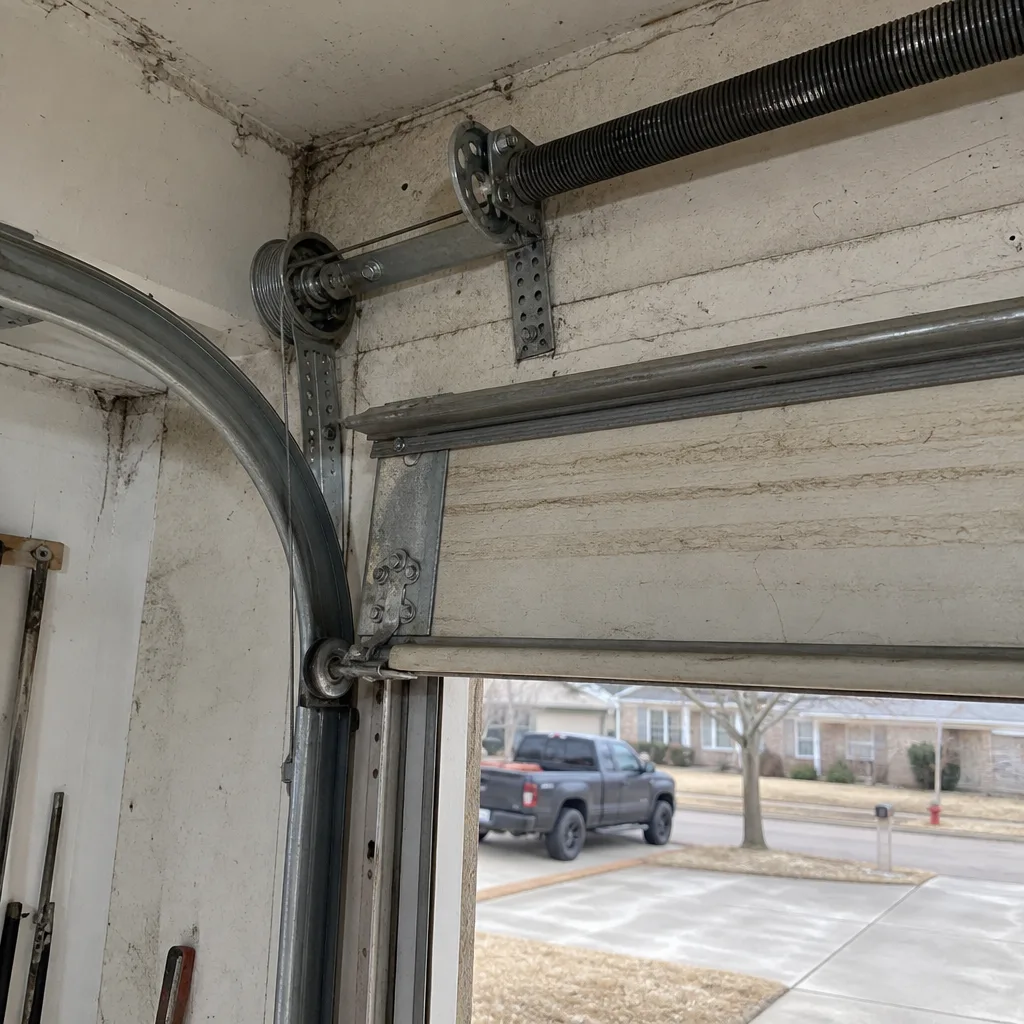
Torsion springs (mounted horizontally above the door):
- Look for a visible gap between coils. Any gap larger than the wire diameter is a no-go. The spring is broken or unwound.
- Look for rust streaks running down the spring. Surface rust is cosmetic. Deep pitting, visible as irregular shadows on the coil surface, indicates section loss and reduced load capacity.
- Check for coil separation symmetry. The gap between adjacent coils should be consistent along the spring’s length. A section with tighter or looser spacing indicates the spring has taken a set, permanently deformed, and lost effective winds.
Extension springs (mounted vertically along the horizontal track):
- Look for the safety cable. A cable should run through the center of each spring. If the safety cable is missing, this is an immediate no-go. A broken extension spring without a safety cable is a projectile hazard.
- Check for stretched appearance. Extension springs at rest should show some coil tension. A spring that appears fully relaxed, with coils touching along its length, has lost its preload and is not contributing lift.
Cable Inspection
The lift cables run from the bottom bracket of the door to the drum (torsion) or pulley (extension). Inspect the full visible length.
- Go standard: Uniform twist, no fraying, no broken strands visible.
- No-go standard: Any broken strand. A 7×19 aircraft cable has 133 individual wires. One broken wire indicates others are stressed beyond yield. The cable is living on borrowed time.
- No-go standard: Rust bloom at the bottom bracket or drum attachment. This is where moisture collects. Rust reduces cable strength by 30 to 50 percent before visible fraying appears.
In Denton, where summer humidity spikes after thunderstorms and winter condensation forms on concrete floors, cable corrosion at the bottom bracket is the most common hidden defect we find during service calls.
Roller Inspection
With the door closed, inspect the rollers at each hinge point.
- Go standard: Roller stem vertical, wheel centered in track, no visible wobble.
- No-go standard: Roller stem angled, wheel riding on track edge, or wheel with flat spots or cracks. A roller that is not rolling is sliding, and it is machining the track with each cycle.
- No-go standard: Missing roller. Surprisingly common. The roller falls out, the hinge still functions, and the door operates on three rollers at that panel until the hinge or track fails.
Panel and Track Gap Symmetry
Stand inside the garage, facing the closed door, and sight along the horizontal line where the door meets the floor. The gap should be uniform left to right, no more than 1/4 inch variation. Then sight vertically along each side. The gap between door edge and track should be uniform top to bottom.
Uneven gaps indicate:
- Door panel damage (collision, vehicle contact, wind load)
- Track misalignment from loose or shifted jamb brackets
- Cable length imbalance (one cable has stretched or slipped on its drum)
- Structural settlement of the garage frame
Any gap asymmetry beyond 1/2 inch is a no-go. The door is operating out of plane and stressing components designed for linear load.
Opener Warning Signs Mistaken for Remote Battery Problems
The most common misdiagnosis in residential garage door service is attributing opener symptoms to remote control failure. Homeowners replace batteries, reprogram remotes, and delay necessary repairs while the opener deteriorates.
The Remote Range Test
Before replacing anything, perform this diagnostic:
- Stand 10 feet from the door and press the remote. Note the response.
- Stand 3 feet from the door and press the remote. Note the response.
- Press the hardwired wall button. Note the response.
If the wall button works perfectly but the remote fails at all distances: The remote or its battery is likely at fault. Replace the battery with a fresh alkaline cell, not a rechargeable. Rechargeable batteries deliver lower voltage that some remotes interpret as weak signal.
If the wall button works but the remote fails at distance and works close: This is antenna degradation, not remote failure. The opener’s logic board antenna, typically a thin wire hanging from the motor head, may be damaged, coiled, or contacting metal. It may also indicate logic board receiver failure, which progresses to total signal loss.
If both wall button and remote are intermittent or slow: This is motor or drive train failure, not signal failure. The opener is receiving the command but cannot execute it reliably.
Motor Failure Signatures
The hum without motion: The motor energizes but the door does not move. This indicates a failed capacitor (the motor cannot develop starting torque) or a seized drive component (the motor cannot overcome mechanical resistance). The capacitor is a replaceable part. A seized drive train may require opener replacement.
The start-and-stop: The motor runs for 2 to 3 seconds, stops, then restarts. This is thermal overload protection cycling. The motor is drawing excessive current, heating its internal breaker, which opens, cools, and resets. Causes include failing motor bearings, binding drive gear, or a door that is mechanically overloaded (springs failing, transferring weight to the opener).
The run-on: The motor continues to run after the door has fully opened or closed. This is limit switch failure. The opener does not know where the door is. In some Genie models, this also triggers the light to stay on indefinitely.
The light flicker: The opener light dims during operation. This indicates voltage drop under load, either from inadequate supply wiring (common in Denton garages with 14-gauge circuits and long wire runs) or from a motor with shorted windings drawing excess current.
At Mainspring Garage Door Co., we stock replacement logic boards, capacitors, and drive gears for LiftMaster, Chamberlain, Genie, and Craftsman openers. When repair exceeds 60 percent of replacement cost, we quote a new unit with the same upfront flat price we use for every job.
How Denton’s Climate Accelerates Specific Failures
Denton’s position on the edge of the Cross Timbers ecological region creates weather patterns that directly affect garage door longevity. Understanding these accelerants helps homeowners interpret warning signs in context.
Thermal Cycling
Denton temperature swings of 30 to 40 degrees in 24 hours are not unusual, particularly during spring and fall frontal passages. Metal components expand and contract with each cycle. A torsion spring in Denton experiences more thermal stress than the same spring in a coastal climate with moderated temperatures. The fatigue life of a spring rated at 10,000 cycles may reduce to 7,000 cycles under Denton’s thermal regime.
This is why we see spring failures cluster in March-April and October-November, when the most extreme daily swings occur.
Hail and Wind Load
Denton sits in the southern extent of Tornado Alley. The April 2021 hail event, with stones exceeding 2 inches, damaged thousands of garage door panels across the city. Less visible: hail-driven debris dents track sections, creating the binding points that cause hesitation and shudder months later.
Wind loading is equally significant. A 60 mph gust on a 16-foot wide door creates over 200 pounds of pressure. Doors in Denton’s open, developing neighborhoods, particularly south of Loop 288, face sustained exposure. The warning sign of wind damage is not always visible panel denting. It is often loose or elongated track mounting holes, or jamb brackets that have pulled 1/8 inch from the frame, enough to misalign the door without obvious visual defect.
Humidity and Condensation
Denton summer dew points above 70 degrees create condensation on cool concrete floors, particularly in shaded north-facing garages. This moisture migrates to bottom brackets, cable terminations, and lower track sections. The rust that forms is often hidden by door travel: the cable moves, exposing fresh metal, while the corroded section remains at the bottom bracket where inspection is difficult.
We recommend a seasonal inspection in September, after the peak humidity months, for homes without climate-controlled garages.
Soil and Foundation Movement
Denton’s black clay soils expand and contract dramatically with moisture. A garage slab that heaves 1/2 inch seasonally transfers stress to the door frame and track mounting points. The warning sign is not door malfunction but gap variation: the door that sealed evenly in spring has a visible light gap at one corner in August.
This is structural, not mechanical, but it creates mechanical failure if ignored. The door operating out of plane wears rollers, bends track, and eventually fails the opener.
Common Mistakes to Avoid
- Ignoring a door that reverses “only sometimes.” Intermittent reversal is a safety system degrading, not a quirk. The same sensor that reverses on phantom obstruction may fail to reverse on real obstruction. In Denton, where grandchildren visit and pets roam, this is not a risk to accept.
- Applying WD-40 to garage door components. WD-40 is a solvent and water displacer, not a lubricant. It dissolves existing grease, attracts dust, and accelerates wear. Use lithium-based grease on metal-to-metal contact points, silicone spray on plastic components. If you are unsure which to use, call for guidance.
- Adjusting torsion spring tension with improvised tools. Torsion springs store enough energy to cause fatal injury. Winding bars must be solid steel, precisely sized to the winding cone, and inserted fully before any tension adjustment. We have responded to emergencies in Denton where homeowners used screwdrivers or pipe wrenches. Do not attempt this.
- Replacing only one spring on a two-spring system. Matched springs age together. A new spring paired with an old spring creates unequal lift, door imbalance, and premature failure of the new spring. We always replace torsion springs in matched pairs, with the same wire size, length, and wind direction.
- Assuming a quiet door is a healthy door. A door that has gradually become quieter may have rollers that have worn so smooth they no longer roll, but slide. The absence of sound can indicate the absence of proper mechanical function. Perform the manual balance test monthly, regardless of noise.
- Waiting for total failure before calling. A door that fails completely often damages additional components in the process. A broken spring allowed to drop the door onto the opener strains the drive system. A cable that snaps with the door mid-travel can twist the door in its tracks, converting a $200 repair into a $1,200 replacement. Early intervention is cheaper intervention.
When to Call a Professional
Call when any no-go condition appears on your visual checklist. Call when a sound changes character, even if the door still operates. Call when a door that was reliable becomes intermittent. Call when you are unsure whether a condition is normal or warning.
Specific scenarios that require immediate professional attention: any visible spring gap or break, any broken cable strand, any door that will not stay open when lifted manually, any opener that hums without moving, any safety reversal system that fails the 2×4 test, and any door that has been struck by a vehicle or fallen object, even if it appears to function normally. Hidden panel damage often manifests as track misalignment weeks later.
Mainspring Garage Door Co. offers free estimates in Denton. Our technicians arrive with springs, cables, rollers, and openers for all major brands on every truck. The flat price is stated before any work begins. Most repairs are completed in a single visit. Call (817) 623-1087.
Frequently Asked Questions
Most common repairs in Denton range from $180 for a cable replacement to $340 for a torsion spring replacement, with opener repairs typically between $150 and $400 depending on the component. We state the flat price before any work begins, and our $50 Off Any Repair Over $250 applies automatically. Call (817) 623-1087 for an exact quote, estimates are free.
A broken torsion or extension spring cannot be repaired; it must be replaced. Springs are manufactured to precise specifications and cannot be spliced or re-welded. We replace springs in matched pairs and back the work with our 90-Day Done Right Promise.
We recommend a professional inspection and tune-up annually, with a supplemental homeowner visual inspection monthly. Our $89 Seasonal Tune-Up includes spring tension verification, safety reversal testing, hardware torque check, and lubrication of all contact points. Given Denton’s thermal cycling and humidity, annual service prevents the failures that cost ten times as much to repair.
This pattern indicates a heat-sensitive binding condition. The most common cause is a door that is marginally out of balance, with a spring system that cannot fully overcome increased friction as components expand in afternoon heat. It can also indicate a failing roller bearing that seizes at temperature. Both conditions progress to total failure. Schedule inspection before the pattern becomes permanent.
No. The price we quote is the price you pay. If our technician discovers additional issues during inspection, we explain them and quote separately before any additional work begins. There are no surprises on the bill. This is how we have operated since 1984.
Yes. Our trucks are stocked with springs, cables, rollers, and openers compatible with all major brands, including discontinued Craftsman and Raynor models common in Denton’s older neighborhoods. If a part is not on the truck, we source it without a second trip charge. Most jobs are completed in a single visit.
The Bottom Line
Your garage door speaks a language of sounds, movements, and visible changes. The pop, the grind, the hesitation, the shudder, the gap that was not there last month, each is a specific signal with a specific meaning and a predictable timeline to failure. Learning this language does not require tools or training. It requires attention, a two-minute monthly inspection, and the willingness to act on warning signs before they become emergencies.
In Denton’s climate, with its thermal swings, hail exposure, and clay soil movement, the margin between warning and failure is narrower than in milder regions. The door that “works fine most of the time” is the door most likely to fail at the worst moment. The homeowner who recognizes the signal and calls early saves money, prevents collateral damage, and avoids the inconvenience of a door that will not open when the car is inside and the day has already started.
We have served Denton homeowners since 2016, and Mainspring Garage Door Co. has stood behind every job since 1984. If your door is showing signs you do not understand, or if you would like us to perform the visual inspection for you, we are available. A live person answers the phone, 24 hours a day.
Written by Carl Dutton, Owner at Mainspring Garage Door Co., serving Denton since 2016.