
Last updated September 10, 2026
Full 25-point door and opener safety check with every visit - springs, cables, rollers, tracks, and your LiftMaster or Chamberlain opener included
You get a price before we start. It does not change when the truck arrives.
 Before
 After
After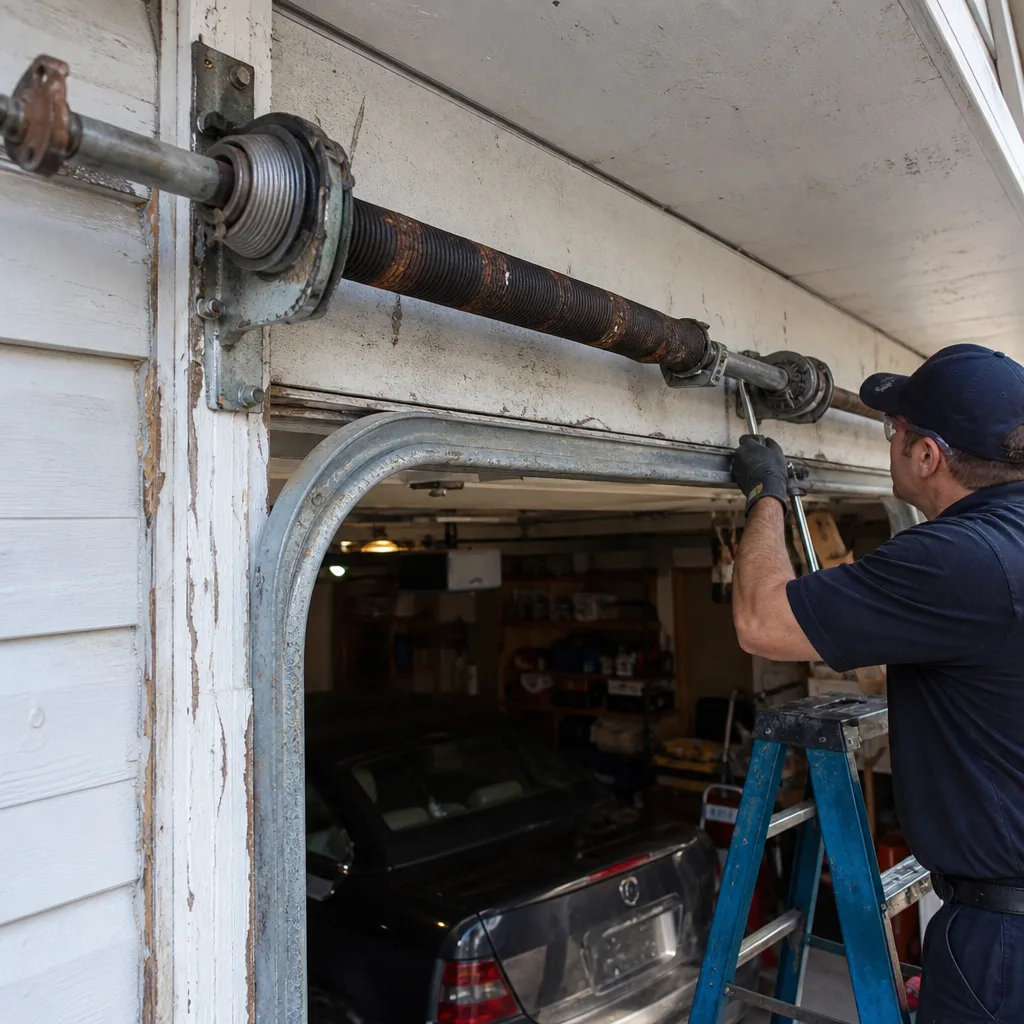 Before
 After
After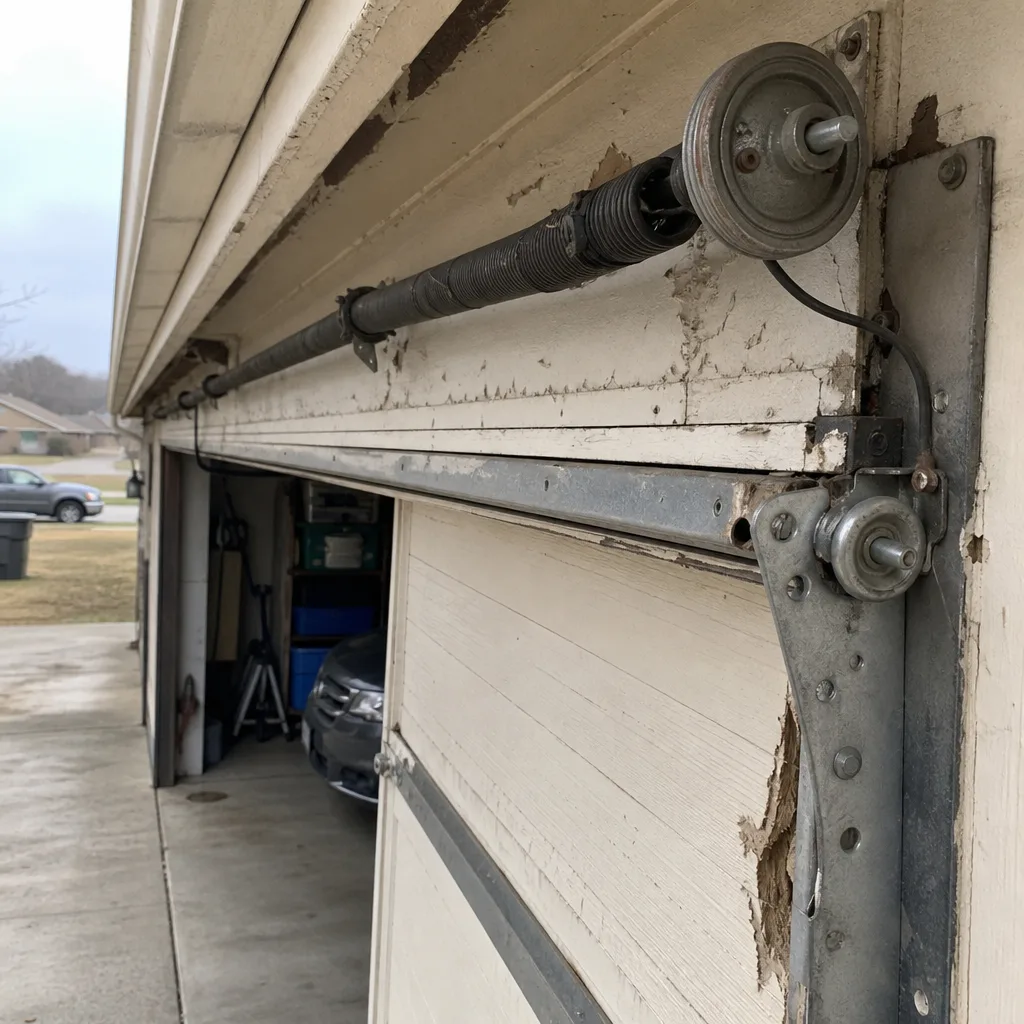 Before
 After
AfterDIY vs Professional Garage Door: The Denton Homeowner’s Decision Guide
A torsion spring on a standard sixteen-foot residential garage door stores roughly the same kinetic energy as a bowling ball dropped from a second-story window. That is not hyperbole. It is the physics that makes your door feel light when you lift it manually, and it is the same physics that sends winding bars through drywall, bone, and car panels when something slips. In Denton, where summer humidity swells wooden door sections and winter northers drop temperatures fast enough to brittle old springs, we see the aftermath of both competent DIY work and catastrophic attempts. This guide draws a clear line between the two. You will learn which repairs are genuinely within reach of a careful homeowner, which two tasks should never be attempted without professional training and tools, and how to calculate the real cost of a repair attempt that does not go as planned. For Garage Door Cost Breakdown: The Denton Homeowner’s Reference for 2026, see our dedicated pricing guide.
Quick Answer
Most Denton homeowners can safely handle bottom seal replacement, sensor realignment, remote reprogramming, and annual lubrication. Torsion spring replacement and cable replacement under load should never be DIY projects, regardless of mechanical experience, because the injury risk is permanent and the cost of professional rescue often exceeds the original service call. Everything else falls on a spectrum where tool access, time value, and warranty protection should guide the decision.
Table of Contents
- The Hard Line: Two Tasks That Should Never Be DIY
- The Genuine DIY Column: What Most Homeowners Can Handle
- Tool Cost Reality Check: What You Actually Need
- When DIY Fails: The Real Cost of a Professional Rescue
- Decision Tree: Symptom In, Correct Path Out
- Denton-Specific Factors: Climate, Codes, and Common Issues
- Warranty, Insurance, and the Fine Print
- Common Mistakes to Avoid
- When to Call a Professional
- Frequently Asked Questions
- The Bottom Line
The Hard Line: Two Tasks That Should Never Be DIY
We have been called to homes in Denton’s Southridge neighborhood where a homeowner spent four hours on a Saturday watching spring replacement videos, purchased the correct diameter spring from a supply house, and still ended up in the emergency room. The spring was right. The winding bars were right. The technique was approximately right. A single moment of inattention during the final quarter-turn was all it took.
Torsion spring replacement and cable replacement under load are the two tasks where no amount of preparation changes the risk equation. Here is why.
Torsion Spring Replacement
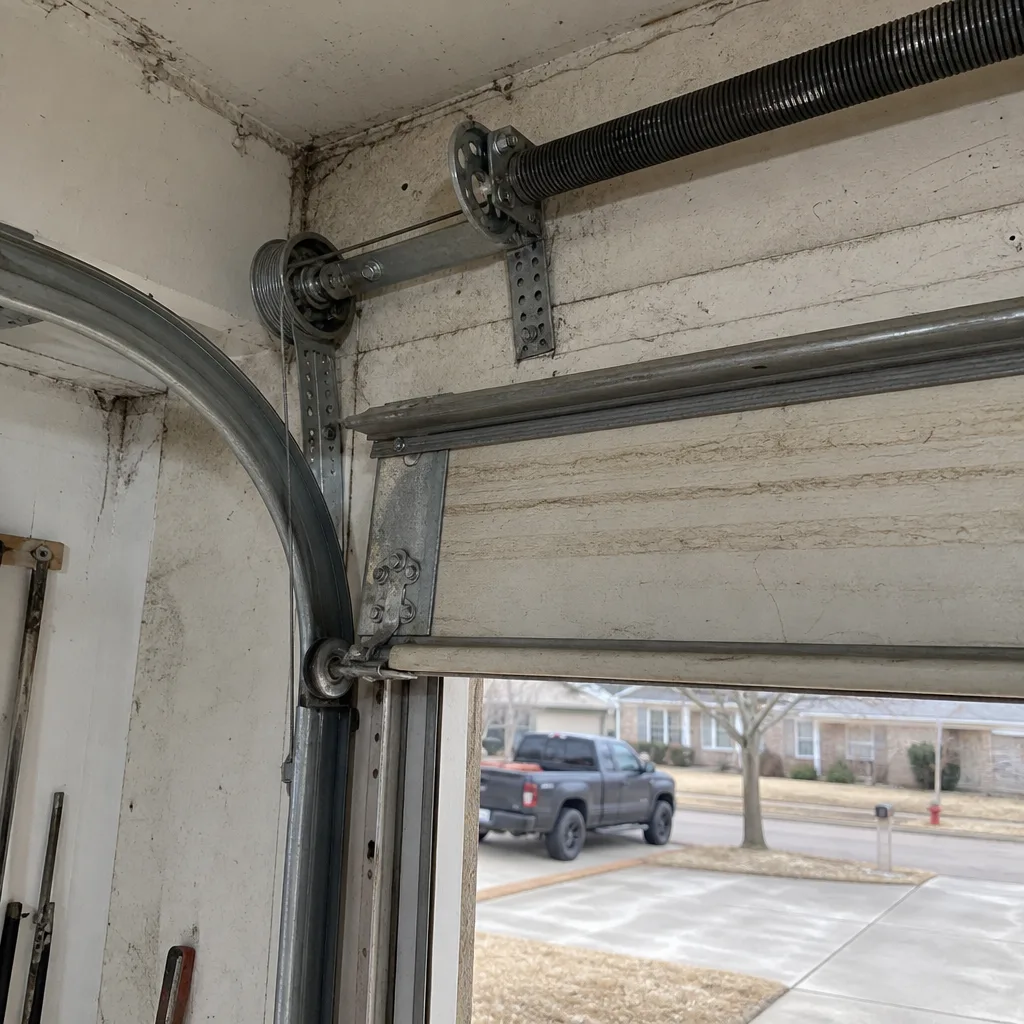
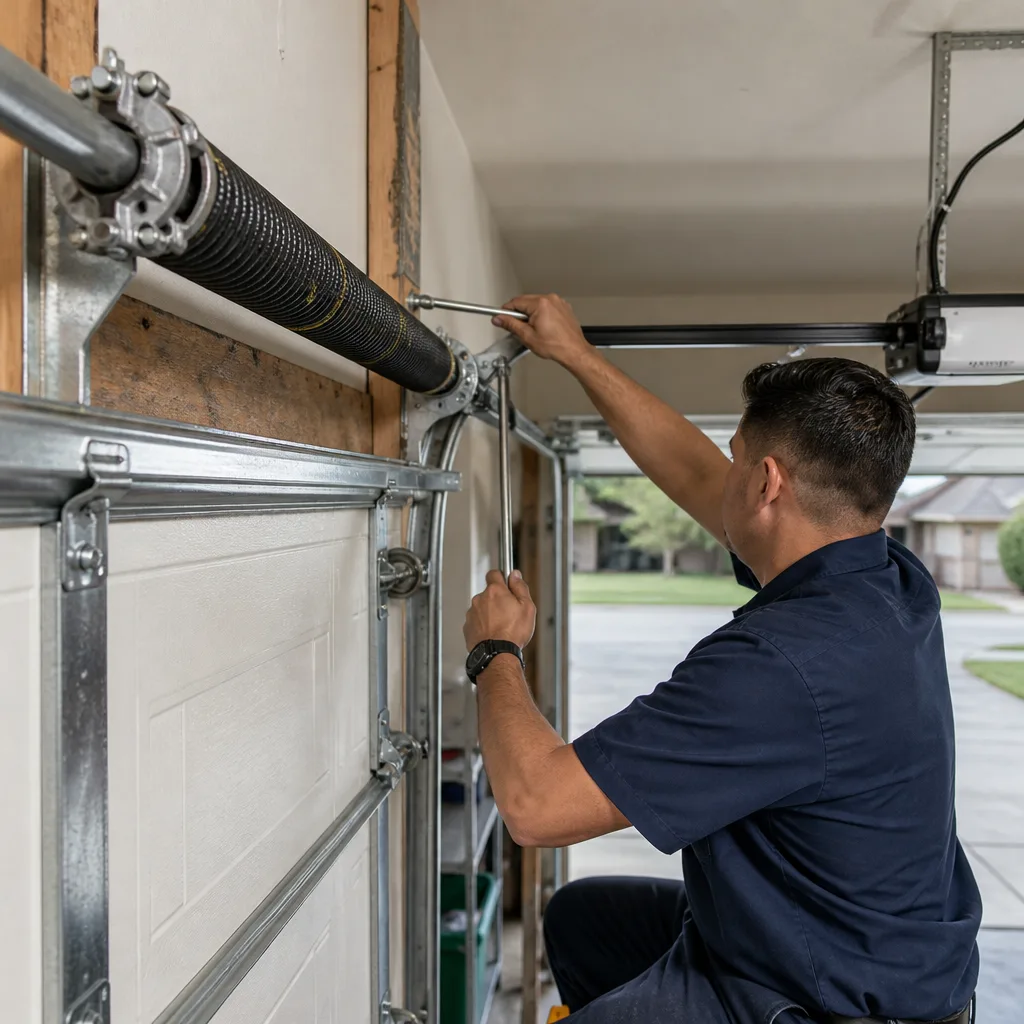
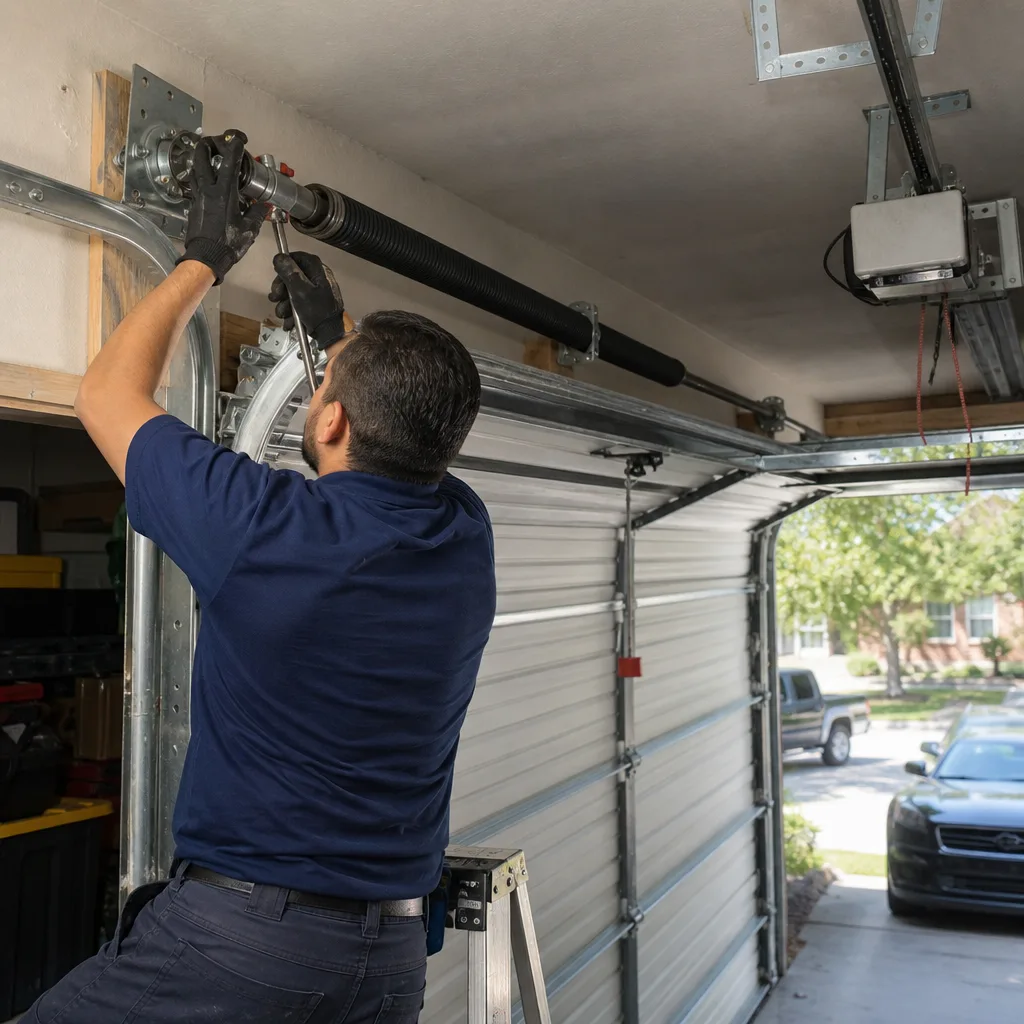
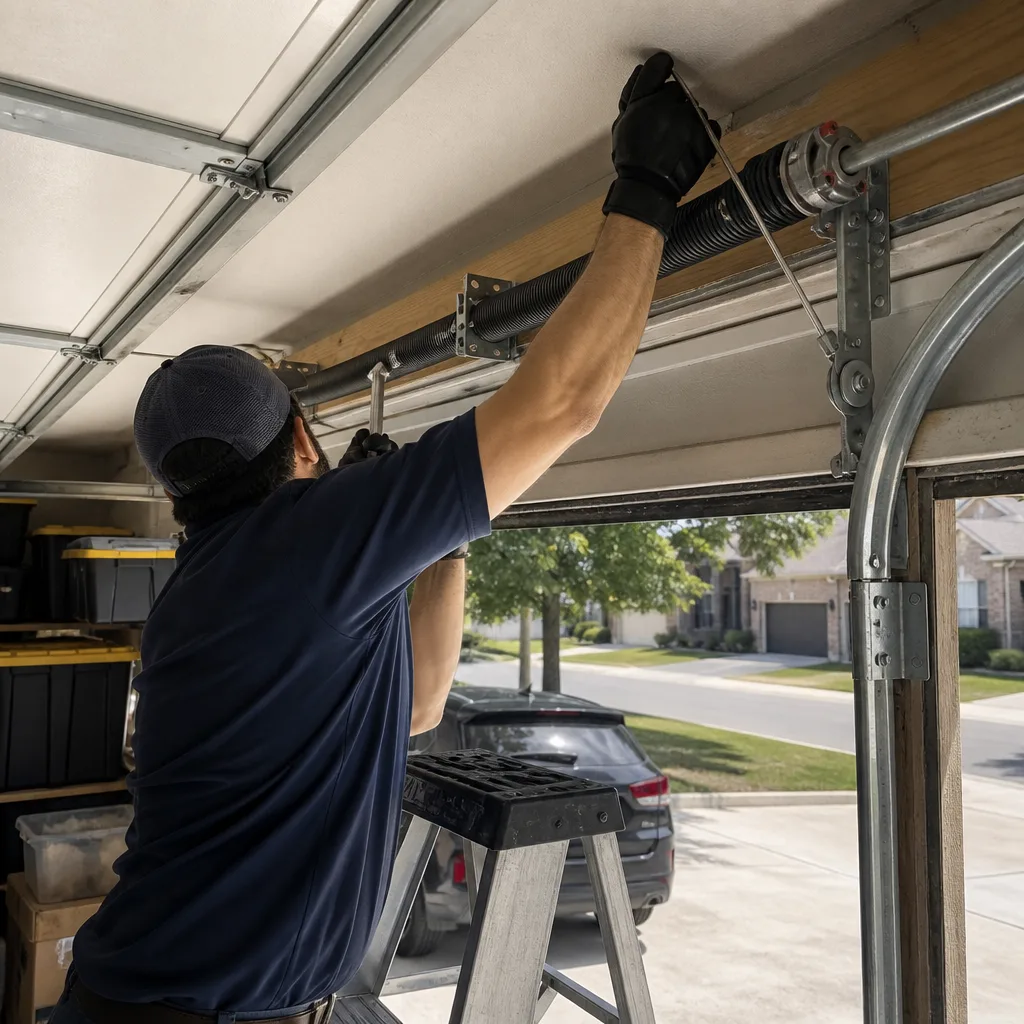
Torsion springs sit above the door on a steel shaft, wound tight enough to counterbalance the full weight of the door, typically 150 to 250 pounds for a double-car residential installation in Denton. The winding process requires inserting solid steel bars into cogs and adding tension, quarter-turn by quarter-turn, while the spring fights back. The bars must be the correct diameter (typically 1/2 inch or 5/8 inch, depending on the system), inserted fully, and held with both hands at all times. Even then, a slip, a cracked spring, or a misaligned cone can release stored energy instantly.
The injuries we have seen in Denton County include facial fractures, hand crush injuries, and one fatality in a neighboring county in 2019. These are not clumsy people. They are homeowners who underestimated the speed at which mechanical failure happens.
Professional spring replacement requires:
- Calibrated winding bars (not screwdriver substitutes, which slip and shatter)
- A working knowledge of door weight-to-torque ratios, which vary by panel material, width, and track configuration
- The ability to set and release tension in controlled increments
- Experience identifying worn cones, bent shafts, and bearing plate fatigue that a novice would miss
We carry every common spring diameter on our trucks. Most garage door repair in Denton jobs are completed in a single visit because we arrive with the parts already matched to the door.
Cable Replacement Under Load
Garage door cables run from the bottom bracket to the drum at each end of the torsion shaft. When a cable frays or snaps, the door often hangs crooked or jams in the tracks. The temptation is to unbolt the bottom bracket, thread a new cable, and reattach. The problem: the bottom bracket is under tension from the spring system even when the door is closed. Removing the bracket without first securing or releasing that tension turns the bracket into a projectile.
Proper cable replacement requires securing the door in the open position with locking pliers or a dedicated door clamp, releasing torsion tension safely, replacing the cable, rewinding the spring, and rebalancing the door. Each step carries the same risks as spring work.
Our position is straightforward. If the repair involves the words “torsion,” “winding,” or “cable under tension,” the work belongs to a trained technician. No YouTube video changes the physics.
The Genuine DIY Column: What Most Homeowners Can Handle
Not every garage door problem requires a service call. Several maintenance and minor repair tasks are genuinely within reach of a Denton homeowner with basic tools and patience. For a complete overview, see our Garage Door Repair Maintenance Checklist for Denton Homeowners. The key is matching the task to your actual comfort level, not the one you imagine after watching a five-minute video.
Bottom Seal Replacement
The rubber or vinyl seal at the bottom of your door hardens, cracks, and lets water and pests through. In Denton, where clay soil expands and contracts with moisture, a compromised seal also allows dust and small debris to accumulate in the track.
Time estimate for first attempt: 45 to 90 minutes.
- Close the door and clamp it to the track at waist height so it cannot roll open.
- Pull the old seal out of the retainer channel from one end. If it is brittle, use needle-nose pliers.
- Clean the channel with a narrow brush and mild detergent.
- Lubricate the channel lightly with silicone spray.
- Feed the new seal in from one end, working it along the channel. A helper holding the opposite end prevents binding.
- Trim excess with a utility knife and test the door for smooth travel.
Seals cost $15 to $35 depending on width and material. The only specialized tool is patience.
Safety Sensor Realignment
Photo-eye sensors sit four to six inches above the floor on both sides of the door opening. When they misalign, the door reverses immediately or refuses to close. In Denton, we see this frequently after lawn equipment bumps the brackets or after foundation shifts common in the area’s expansive clay soils.
Time estimate for first attempt: 15 to 30 minutes.
- Check for obvious obstructions: spider webs, leaves, or mud on the lenses.
- Loosen the wing nut on one sensor bracket and adjust until the LED indicator changes from blinking to solid.
- Repeat on the opposite side if needed.
- Test by closing the door and waving a broomstick through the beam. The door should reverse within two seconds.
If both LEDs show solid but the door still misbehaves, the issue is likely wiring or logic board failure, which crosses into professional territory.
Remote and Keypad Reprogramming
Most openers manufactured after 2010 use a simple learn-button process. For LiftMaster, Chamberlain, and Craftsman units common in Denton subdivisions built in the 1990s and 2000s, press the purple, red, or yellow learn button on the motor unit, then press the remote button within thirty seconds. Keypads require entering a temporary PIN sequence. Consult your owner’s manual for the specific color-code protocol, as it varies by manufacturing year.
Time estimate: 10 to 20 minutes if you have the manual. Add thirty minutes of online searching if you do not.
Annual Lubrication
We recommend this every October, before Denton’s temperature swings stress metal components. Use a silicone-based spray or white lithium grease on rollers, hinges, and the top of the rail. Never lubricate the track itself, which causes slippage and uneven travel. Wipe excess. The entire job takes twenty minutes and extends component life measurably.
Tool Cost Reality Check: What You Actually Need
The internet will tell you that torsion spring work requires “$40 in winding bars and a can-do attitude.” This is technically true about the bars and dangerously incomplete about everything else.
Here is the actual tool and knowledge inventory for safe spring work:
| Item | Cost | Purpose | What the Video Does Not Mention |
|---|---|---|---|
| Solid steel winding bars (2) | $35-$50 | Safe tension add/release | Must be solid steel, exact diameter; pipe or screwdriver substitutes fail catastrophically |
| Winding cone wrenches | $25-$40 | Hold cones during adjustment | Different manufacturers use different cone profiles; wrong wrench rounds the cone |
| Spring gauge or caliper | $15-$30 | Measure wire diameter | 0.005 inch variance changes torque by 10%; eyeballing fails |
| Door scale or known weight | $50+ or calculation | Determine correct spring IPPT | IPPT (inch-pounds per turn) varies by door weight, track radius, and drum size |
| Vice grips / locking pliers (2 pair) | $20-$35 | Secure door and shaft | Must hold positively; cheap versions slip under load |
| Knowledge of local wind load requirements | Years of experience | Correct spring specification | Denton sits in a 90-mph wind zone per IRC; heavier doors need different springs |
The $40 figure covers winding bars alone. The full inventory runs $150 to $250 for tools you will use once every eight to twelve years, assuming you remember the correct procedure each time. More critically, the tools are only half the equation. The other half is knowing that a sixteen-by-seven steel-back door with a twelve-inch radius track and a standard lift drum requires a different spring than the same door with a fifteen-inch radius track and a high-lift drum. We specify springs by measuring door weight, track geometry, drum type, and desired cycle life. A homeowner guessing at any of these variables installs a spring that is either dangerous (over-wound, stressing hardware) or short-lived (under-specified, failing in two years instead of ten).
For garage door installation in Denton, the same principle applies: the tools are available, but the specification knowledge is not.
When DIY Fails: The Real Cost of a Professional Rescue
We respond to “rescue calls” in Denton several times each month. These are not full repairs. They are interventions after a homeowner has begun work, encountered a problem, and needs a technician to finish or undo the attempt. The cost structure surprises people.
Scenario: Attempted spring replacement, spring purchased, wound incorrectly, door jammed crooked.
- Spring purchased from supply house: $80-$140
- Winding bars and tools purchased: $60-$120
- Time invested: 3 to 5 hours
- Rescue service call to remove incorrect spring, assess hardware damage, install correct spring, rebalance door: $280-$420
- Additional parts if cones, cables, or bottom brackets were damaged during the attempt: $45-$180
Total: $465 to $860 for a repair that would have cost $180 to $340 if called from the start.
The math worsens if the door was opened and closed on an incorrectly wound spring, which damages the opener gear set. A stripped Craftsman or Raynor opener gear adds $150 to $280 to the bill. In some cases, the opener itself requires replacement.
There is also the non-monetary cost: a Saturday lost, a spouse’s patience exhausted, and the psychological weight of having a non-functional garage door while waiting for the next available appointment. During Denton’s spring storm season, our schedule fills two to three days out. A rescue call may not be same-day.
Our pricing is stated upfront before any work begins. The flat price covers diagnosis, parts, labor, and the 90-Day Done Right Promise. No surprises on the bill, even for rescue work.
Decision Tree: Symptom In, Correct Path Out
Use this framework for any garage door problem. Start with the symptom and follow the path to the appropriate response.
Symptom: Door will not open or close with remote or wall button
- Check if the opener motor hums or clicks. If silent, verify power at the outlet and test the GFCI.
- If motor hums but door does not move, disconnect the opener by pulling the red release cord and attempt to lift manually.
- If door lifts smoothly by hand, the opener has failed. Professional repair or replacement is indicated. See our garage door opener in Denton service page.
- If door is heavy or jammed, a spring or cable has failed. Professional repair required. Do not operate.
Symptom: Door reverses immediately or partway down
- Check sensor alignment and lens cleanliness. Adjust if needed.
- Test force sensitivity settings per manufacturer instructions.
- If problem persists, inspect for binding in the track or damaged rollers.
- Lubricate hinges and test. If still reversing, professional assessment needed for track alignment or opener logic board issues.
Symptom: Loud grinding, squealing, or popping noise
- Identify location: opener motor, track/roller interface, or spring area.
- Opener motor grinding: likely gear failure. Professional.
- Roller/track noise: lubricate and inspect for flat-spotted rollers. Replace rollers if worn (DIY possible with caution; professional recommended for bottom rollers under cable tension).
- Popping from spring area: spring is fatiguing or slipping on shaft. Professional. Do not attempt to adjust.
Symptom: Door hangs crooked or one side lifts faster
- Inspect cables for fraying or detachment.
- If one cable is slack or broken, the door is under uneven tension. Professional. Do not attempt cable work.
- If cables appear intact, a spring may be fatiguing unevenly. Professional assessment.
Symptom: Gap at bottom, light or water visible under door
- Inspect bottom seal for cracking or shrinkage.
- Check for debris or concrete spalling preventing full closure.
- Replace seal if damaged. DIY appropriate.
- If seal is intact but gap persists, track or panel alignment may be off. Professional.
Symptom: Remote or keypad intermittent or non-responsive
- Replace remote battery.
- Reprogram per manufacturer learn-button protocol.
- If multiple remotes fail simultaneously, antenna or logic board issue. Professional.
Denton-Specific Factors: Climate, Codes, and Common Issues
Garage doors in Denton face conditions that shape both failure modes and repair decisions. Understanding these local factors-along with Garage Door Permits, Codes & Inspections in TX: What You Need to Know-helps homeowners anticipate problems and choose appropriate responses.
Climate and Material Stress
Denton’s climate is classified as humid subtropical with hot summers and mild winters, but the transition periods are abrupt. A forty-degree temperature swing in forty-eight hours is common in March and November. This thermal cycling stresses steel springs through repeated expansion and contraction, accelerating metal fatigue. We see the highest volume of spring failures in early April and late October, directly following these swing periods.
Summer humidity affects wooden door sections in older Denton neighborhoods like the Historic District and areas near Quakertown Park. Swollen panels bind in the tracks, stressing openers and hardware. Homeowners sometimes misdiagnose this as an opener problem and replace a perfectly good LiftMaster or Genie unit when the real issue is panel clearance.
Soil and Foundation
The black clay gumbo soil underlying much of Denton expands when wet and shrinks dramatically in drought. This movement shifts garage slabs and door frames, throwing tracks out of plumb. A door that operated smoothly in May may grind and bind by September. Track realignment is not a DIY task; it requires precise measurement and often concrete wedge installation at the jamb anchors.
Wind Load and Building Code
Denton County adopts the International Residential Code with local amendments. The designated wind speed for garage door installation is 90 mph for standard residential construction. Doors in newer subdivisions like Robson Ranch or Paloma Creek must carry wind load stickers documenting compliance. If you replace a door yourself and the installation lacks proper wind load documentation, you may face issues with home sale inspections or insurance claims after storm damage.
Our technicians are familiar with Denton County inspection requirements and install to code on every job, with documentation provided.
Common Neighborhood Patterns
In the 1970s and 1980s subdivisions near Texas Woman’s University, we frequently encounter Wayne Dalton TorqueMaster spring systems, which use an enclosed spring tube rather than exposed torsion springs. These require specialized tools and knowledge that general DIY resources rarely address. Attempting to open a TorqueMaster tube without the correct winding tool destroys the internal components and converts a $240 repair into a $600+ door replacement.
In newer construction south of Loop 288, builder-grade openers are often under-specified for the door weight. We replace more opener gear sets in five-year-old homes than in twenty-year-old homes because the original installation paired a 1/2-horsepower unit with a heavily insulated wide door.
Warranty, Insurance, and the Fine Print
The DIY-versus-professional decision has downstream consequences that many homeowners discover only after a problem occurs.
Manufacturer warranties on openers and door sections typically require professional installation for coverage. A self-installed opener that fails within the warranty period may be denied if the manufacturer determines improper installation contributed to the failure. We have processed warranty claims for LiftMaster, Chamberlain, and Genie units where our installation documentation was required for approval.
Homeowner’s insurance policies vary in their treatment of DIY repairs. If a self-repaired door fails and damages a vehicle or injures a person, the insurer may dispute coverage based on negligent maintenance. Professional repair with documented invoice provides a clear chain of responsibility.
Our 90-Day Done Right Promise applies to every completed job. If the work is not right, we return at no charge. The promise is stated in writing on every invoice. No paperwork to file, no dispute process, no argument. This is separate from and in addition to manufacturer warranties. DIY repairs carry no comparable protection.
For homeowners in Denton who plan to remain in their homes long-term, the value of documented professional work accumulates. When you eventually sell, a folder of maintenance records from a local company with forty-two years of history signals care to buyers and inspectors alike. Explore more guides & resources for maintaining your home’s value.
Common Mistakes to Avoid
- Using the wrong spring. Homeowners often match the old spring’s length and diameter without checking wire gauge or cycle rating. A spring with correct dimensions but wrong wire size will fail prematurely and may not balance the door correctly, damaging the opener.
- Substituting tools. Screwdrivers, socket extensions, or pipe segments used as winding bars have no place near a torsion system. We have seen pipe segments bend and release unexpectedly, and screwdrivers shatter under torque. The correct tool is non-negotiable.
- Ignoring track alignment after spring work. Even a correctly installed spring will fatigue faster if the door travels in a twisted or binding track. Track plumb and parallel must be verified with a level, not by eye.
- Overtightening opener downforce settings. When a door feels heavy after spring work, some homeowners increase the opener’s downforce to compensate. This creates a crushing hazard and accelerates gear wear. The correct response is proper spring tension, not force adjustment.
- Neglecting the safety reverse test. Federal law requires automatic reversal upon contact. After any repair, place a 2×4 flat on the floor and verify the door reverses within two seconds of contact. Test monthly thereafter. In Denton, where children and pets use garages as play space, this is not optional.
- Assuming all brands work the same. A Raynor door with a proprietary bottom bracket requires different handling than a standard Clopay or Amarr setup. Manufacturer-specific hardware is not interchangeable, and forcing standard parts into proprietary fittings creates failure points.
- Waiting too long on frayed cables. A cable with three visible frays is a cable that will snap. In Denton’s temperature-cycling climate, the final failure often happens at the worst possible moment, typically when you are leaving for work or arriving in a storm. Address fraying cables promptly through professional service.
When to Call a Professional
Call a professional when the repair involves torsion springs, cables under load, track realignment, opener internal components, or any condition where incorrect work creates safety risk or compounds damage. Call when you have begun a repair and encountered unexpected resistance, unfamiliar hardware, or a result that does not match the tutorial. Call when your time is worth more than the savings, when the repair must be right the first time, or when you simply want the assurance of documented work backed by a written guarantee.
Mainspring Garage Door Co. offers free estimates in Denton. We answer the phone with a live person, 24 hours a day, including nights, weekends, and holidays. Our technicians arrive in uniform, with background checks completed, and carry the parts needed for most repairs on the truck. The price is stated before any work begins. If you are uncertain whether a repair is within your reach, call us at (817) 623-1087 and we will talk through it honestly. We have no interest in selling you service you do not need.
Frequently Asked Questions
Standard torsion spring replacement in Denton typically runs $180 to $340 for a single spring, or $280 to $480 for a dual-spring system, depending on door size, spring specification, and whether additional hardware requires replacement. We state the exact price before beginning work. Call (817) 623-1087 for a free estimate.
On a dual-spring door, which is standard for sixteen-foot and wider installations, we recommend replacing both springs simultaneously. The springs have performed identical cycles and fatigue at similar rates. Replacing one leaves the other as a near-term failure risk, and the uneven torque stresses the door and opener. The additional cost of the second spring is modest compared to a second service call.
Standard springs are rated for 10,000 cycles (one open and one close). At four cycles per day, that is roughly seven years. High-cycle springs rated for 25,000 to 50,000 cycles are available and recommended for households with multiple drivers or frequent garage access. Denton’s thermal cycling may modestly accelerate fatigue compared to more stable climates.
No. Our price is quoted and agreed before any work starts. If we discover additional issues during inspection, we explain them and provide a revised quote for your approval before proceeding. You will never receive an invoice larger than the agreed price without explicit prior authorization.
Our trucks are stocked with springs, cables, rollers, hinges, openers, and logic boards for all major brands. Most Mainspring Garage Door Co. home service visits in Denton are completed in a single trip. We do not charge return trip fees for parts we should have carried.
We maintain a permanent 5% discount for seniors and veterans, applied to any repair or installation service. Mention eligibility when scheduling. This is not a limited promotion; it has been in place for years and will remain.
The Bottom Line
The DIY-versus-professional question is not a test of your competence. It is a calculation of risk, cost, and value. In Denton, a homeowner with patience and basic tools can maintain a garage door well, replace a bottom seal, align sensors, and keep components lubricated. These tasks save money and build familiarity with your home’s largest moving object. But torsion spring work and cable replacement under load belong to trained technicians with the right tools and the experience to use them. The injury risk is permanent, the cost of a failed attempt typically exceeds professional service, and the peace of a job done right, in writing, with a guarantee behind it, is worth more than the modest savings of doing it yourself.
We have served Denton and surrounding communities since 1984. We answer the phone live, day or night. We quote flat prices before we start. And we stand behind every job with the 90-Day Done Right Promise. If you are weighing a repair and want an honest assessment of whether it belongs in your garage or ours, call us. We will tell you straight.
Written by Carl Dutton, Owner at Mainspring Garage Door Co., serving Denton since 2016.